


For customers who already understand the basics of screw air compressors, a common question is:
Why can a two-stage screw compressor achieve higher efficiency than a single-stage compressor?
The answer is not simply that it has “two air ends.”
The main advantage comes from how the compression ratio is distributed between the two stages and how the air is cooled between them.
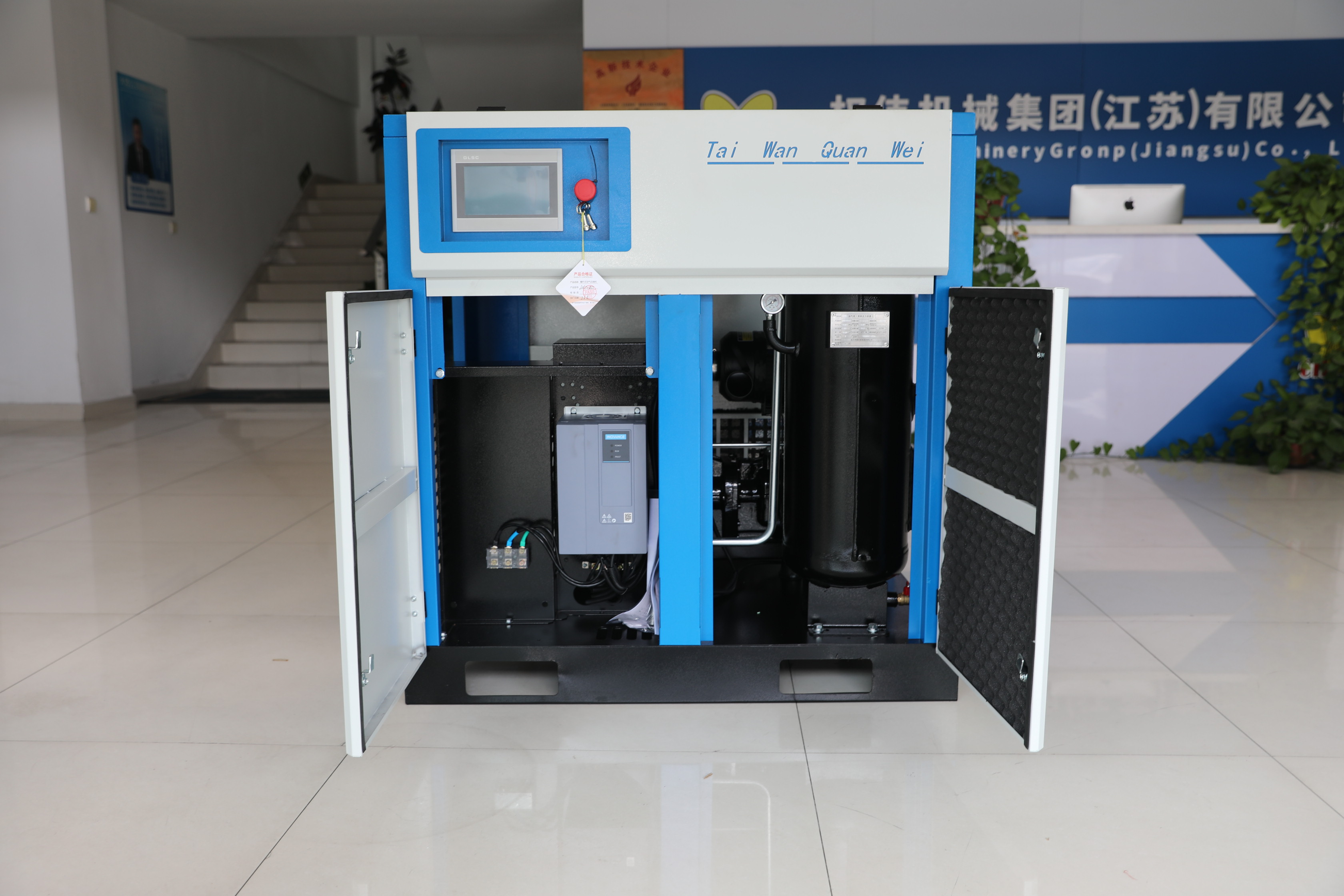
A screw compressor needs to increase atmospheric pressure to the required discharge pressure. The larger the pressure increase, the greater the compression work.
In a single-stage compressor, the entire pressure increase takes place in one compression stage.
A two-stage compressor divides the overall compression process between two stages:
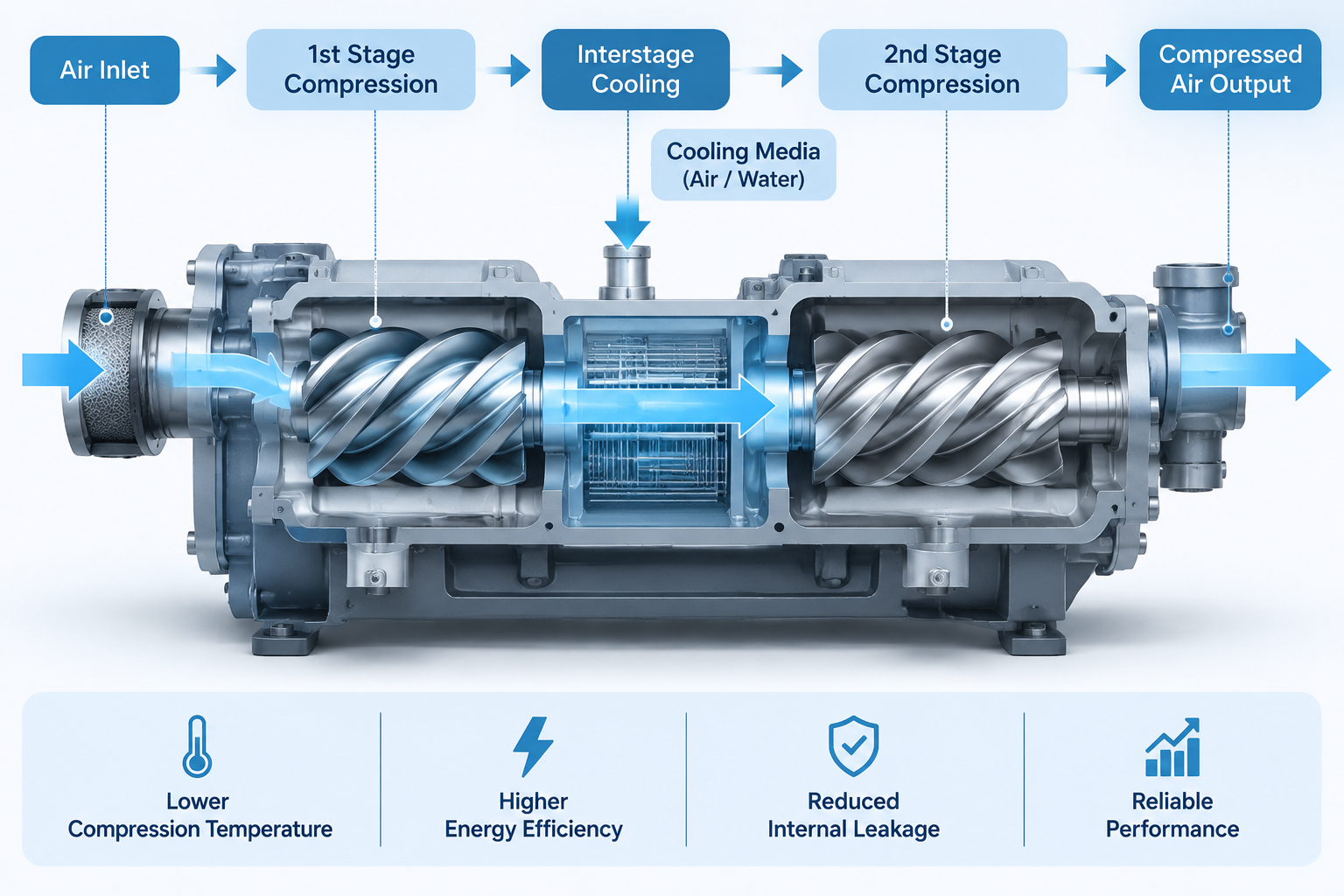
Inlet → 1st Stage → Interstage Cooling → 2nd Stage → Final Discharge
This reduces the compression ratio handled by each individual stage.
For example, industry technical material gives a comparison at 100 psi: a single-stage compressor has an overall absolute compression ratio of about 7.9:1, while a two-stage design can divide the compression into approximately 2.9:1 in the first stage and 2.7:1 in the second stage. The exact ratios depend on the compressor design and operating conditions.
Compressing air generates heat.
When the entire compression process is completed in one stage, the air experiences a large pressure increase and a corresponding temperature rise.
In a two-stage design, the air is partially compressed in the first stage and then cooled before entering the second stage.
This interstage cooling reduces the temperature of the air before the second compression stage.
The result is a more favorable compression process and improved thermal management. Multi-stage compression with intercooling is also widely used when higher pressure ratios need to be achieved efficiently.
It is easy to think of the intercooler as simply a device for lowering air temperature.
Its role is more important than that.
After the first stage, the compressed air is cooled before entering the second stage. Lowering the air temperature reduces the work required for the subsequent compression compared with compressing the hotter air directly.
This is one of the fundamental reasons why two-stage compression can improve energy efficiency.
The design also helps manage the thermal load of the compressor, which is particularly valuable when the machine operates continuously.
Vertical two stage similar
Another factor is internal leakage.
In a screw compressor, some compressed air can leak internally from the higher-pressure side back toward the lower-pressure side.
The larger the pressure difference across the compression element, the greater the potential leakage loss.
By dividing the overall compression process between two stages, the pressure difference handled by each stage can be reduced.
Industry technical material identifies this reduction in differential pressure as another reason for the power advantage of two-stage compression.
This is especially important when comparing compressors.
A 75 kW compressor is not necessarily more efficient than another 75 kW compressor simply because both have the same motor rating.
A more useful performance indicator is specific power.
In simple terms:
Specific Power = Input Power ÷ Airflow
For example, when comparing two compressors operating at the same pressure, a machine producing more airflow for the same input power has a lower specific power and is generally more energy-efficient.
Performance should therefore be compared under equivalent conditions, including:
Working pressure
Airflow
Input power
Operating conditions
This is why compressor selection should go beyond simply comparing motor kW.
Not automatically.
The efficiency advantage of two-stage compression depends on the compressor design and operating conditions.
For example, Hitachi/Sullair technical material states that its two-stage rotary screw compressors can offer a 12–15% power advantage compared with equally sized single-stage compressors under the specified comparison conditions. This should be understood as a product- and test-condition-specific comparison, not a universal saving rate for every two-stage compressor.
When evaluating two compressors, it is therefore better to compare their actual performance data at the same pressure and airflow requirements.
Two-stage compression can be particularly attractive when:
The compressor operates for long hours.
Air demand is relatively high.
Energy consumption is an important part of operating cost.
The required pressure creates a relatively high compression ratio.
The potential energy savings can justify the additional investment.
For some applications with lower pressure requirements or shorter operating hours, a well-designed single-stage compressor may still be the more economical choice.
The correct question is therefore not:
“Is two-stage better than single-stage?”
but:
“Which compression technology provides the best performance for this operating profile?”
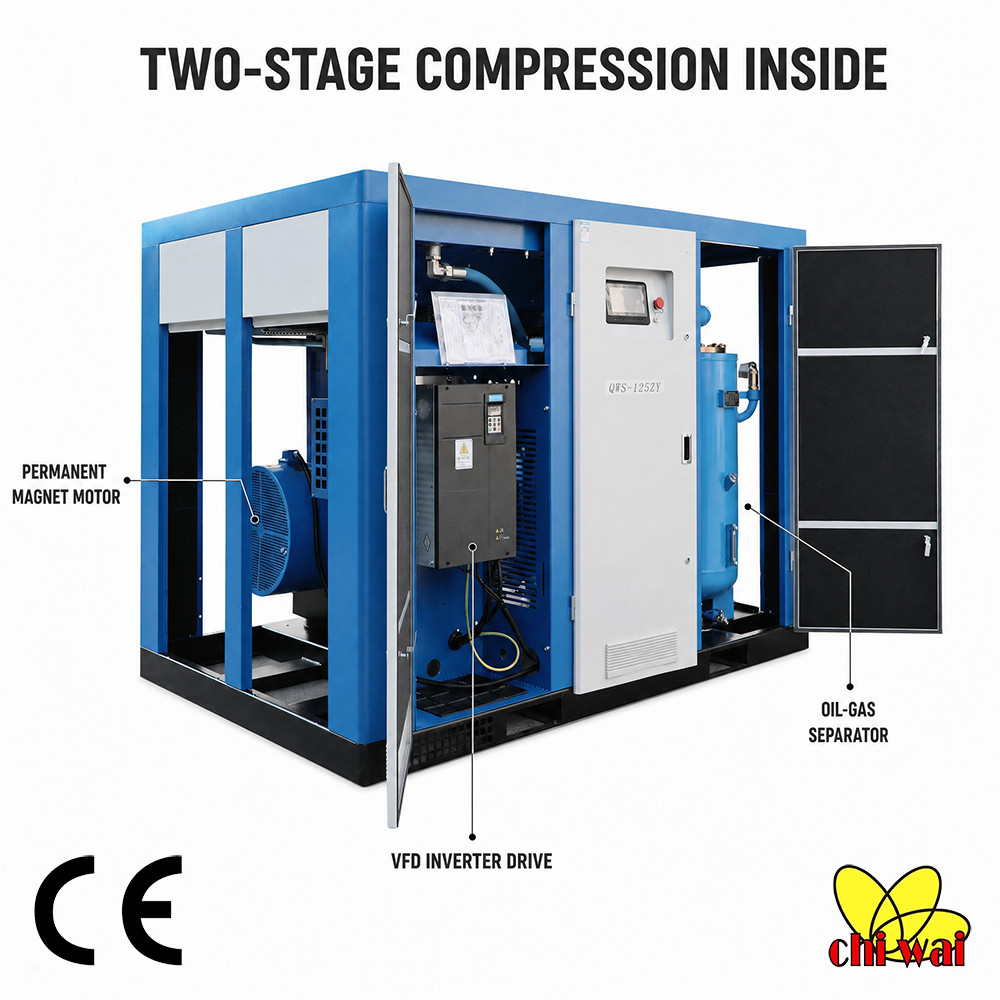
The energy advantage of a two-stage screw compressor comes from several factors working together:
Divided compression ratio → Interstage cooling → Lower pressure difference per stage → Reduced compression losses
This can improve compression efficiency and thermal management compared with a single-stage design under suitable operating conditions.
For customers comparing compressors, specific power, airflow and working pressure are more meaningful than motor power alone.
Understanding these parameters makes it easier to evaluate whether a two-stage screw compressor is a worthwhile choice for a particular application.
Looking for a two-stage screw compressor for your application? Contact Quanwei Machinery to discuss your required airflow, working pressure and operating conditions.
ລົງທະບຽນຈົດຫມາຍຂ່າວຂອງພວກເຮົາເພື່ອໄດ້ຮັບຂໍ້ມູນຂ່າວສານການປັບປຸງ, ການສົ່ງເສີມແລະຄວາມເຂົ້າໃຈ.

 IPv6 network supported

